Adversarial Thesis Testing
1. The problem
Teams increasingly ask language models for a verdict on an investment claim. A popular fix for one-sided answers is to force a bull case and a bear case first. That sounds rigorous. It is not obviously better than one researcher who must cover both sides on the same token budget.
Two confounds matter:
- Length. More text can look like more reasoning even when structure is irrelevant.
- Tone authorship. If you cast the bear as a short seller, the number may move because you rewrote the prompt, not because “debate topology” works.
2. Setup
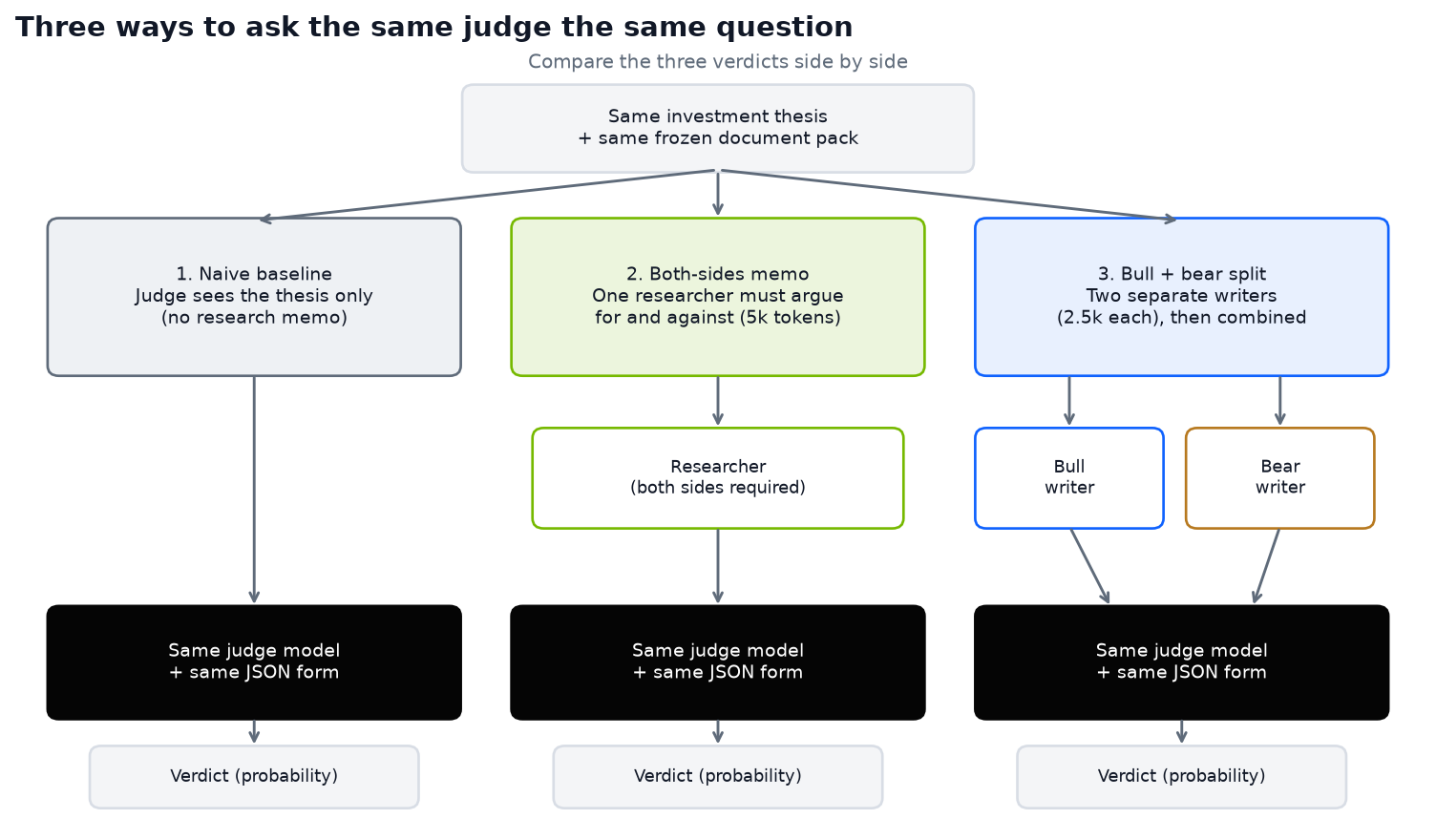
Every comparison uses the same thesis text, the same frozen document folder, and the same judge instructions and output form.
| Setup (plain name) | What the judge receives | Why it exists |
|---|---|---|
| Naive lab label: A |
Thesis only. No research memo. | “Just ask the model” baseline. |
| Both-sides memo lab label: B |
One researcher must argue for and against (~5,000 tokens). | Controls for length / deliberation. |
| Split bull + bear lab label: C |
Separate bull and bear writers (~2,500 each), combined for the judge. | The “adversarial” treatment, same total budget as the memo. |
Writers use a local 8B model (qwen3:8b). The judge is a different model family so writers are not graded by their own style.
Grid: 3 demo theses × 5 intensity settings × 3 setups × 10 repeats = 450 runs (444 clean, 1.3% error).
3. Results
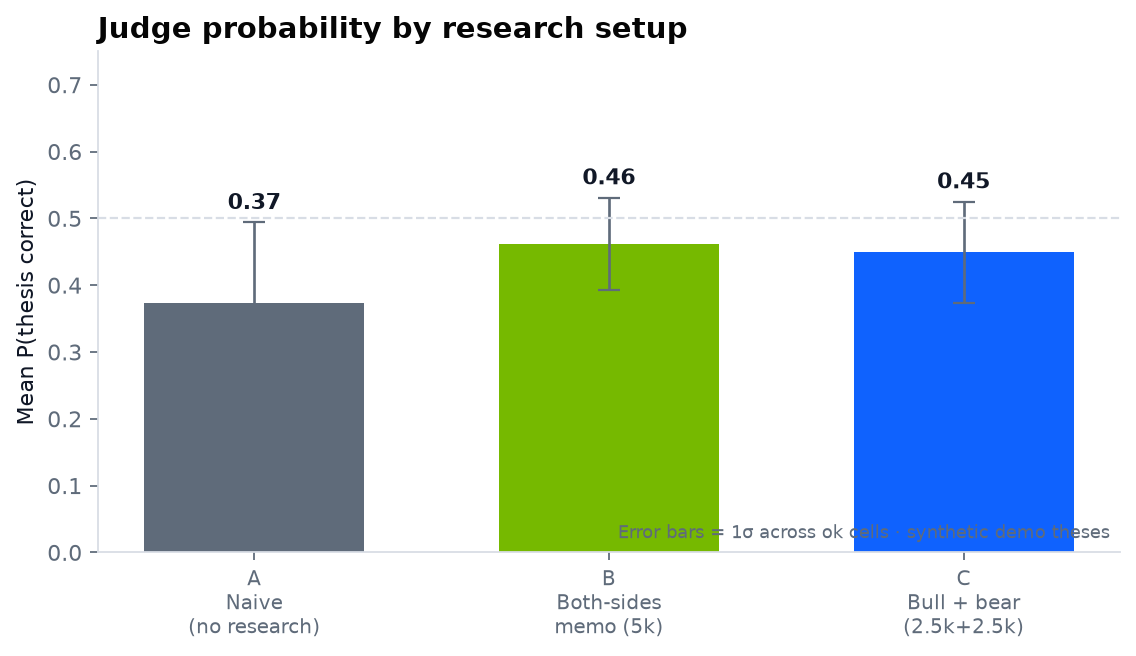
Average probability by setup
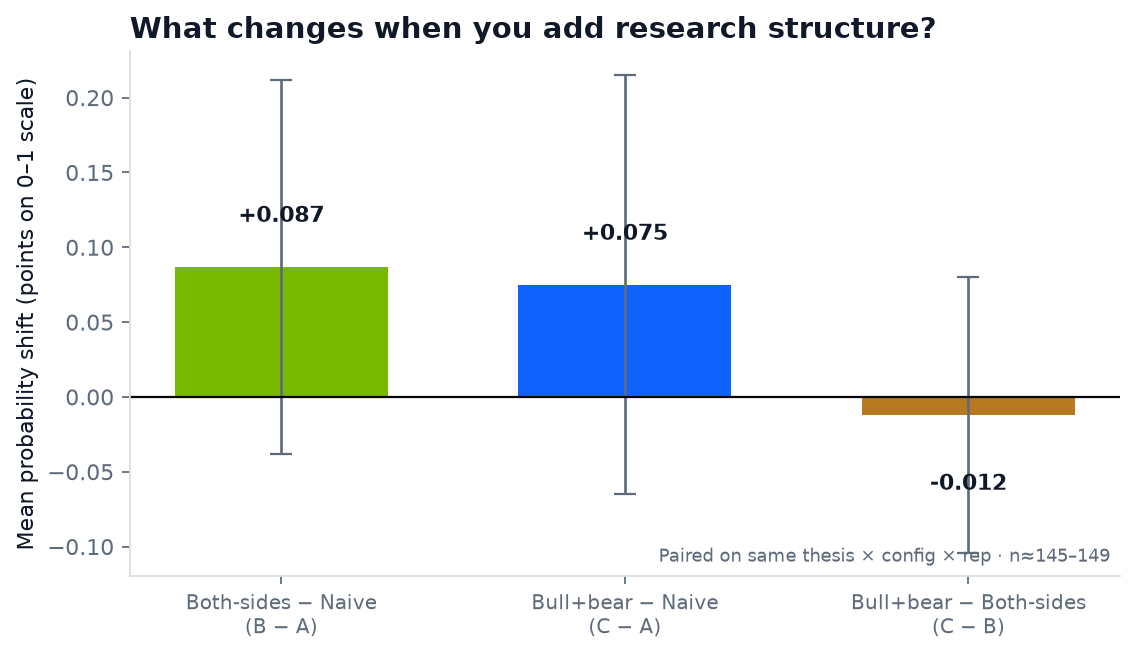
Paired shifts (same thesis, setting, and repeat)
| Comparison | n | Mean shift | Spread (σ) |
|---|---|---|---|
| Both-sides memo − Naive | 149 | +0.087 | 0.125 |
| Split debate − Naive | 145 | +0.075 | 0.140 |
| Split debate − Both-sides memo | 145 | −0.012 | 0.092 |
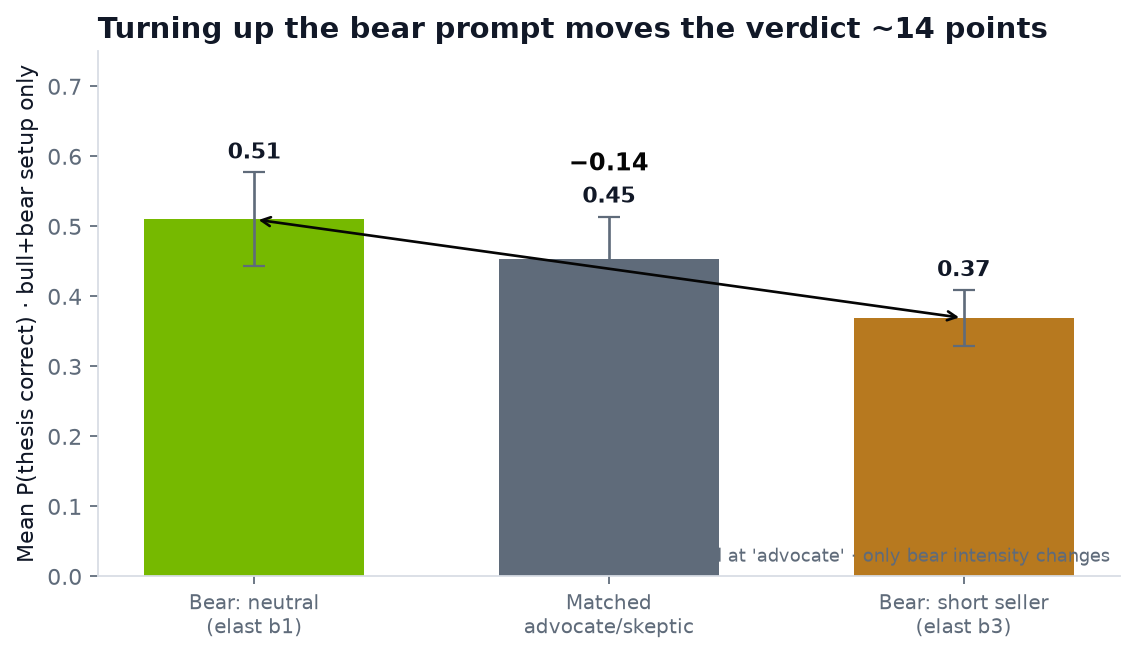
Intensity: the real dial inside split debate
Holding the bull at “advocate” and only making the bear harsher moves mean probability from about 0.51 (mild bear) to 0.37 (short-seller bear), roughly 14 points.
4. Kill-condition quality (50-run sample)
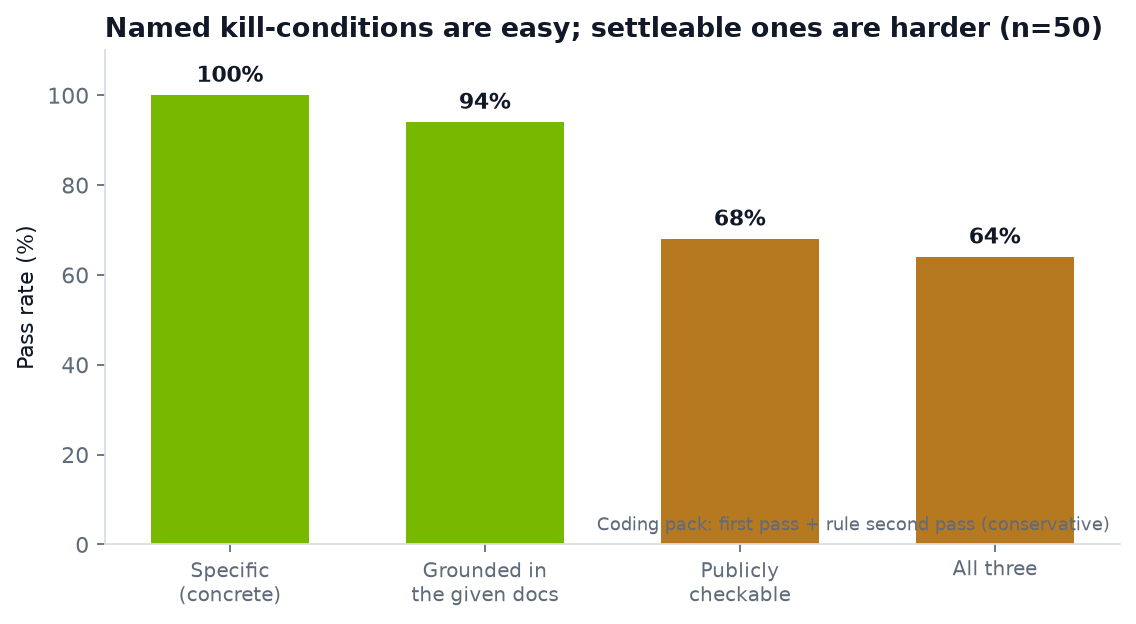
Each verdict must name a primary falsifier (a concrete condition that would kill the thesis). I scored a stratified sample of 50 outputs:
- Specific: concrete threshold/event, not vibes
- Grounded in the given docs: fair given the frozen folder
- Publicly checkable in form: settleable later from prices / filing-style lines / announced events
After a first pass plus a conservative automated rule pass: 100% / 94% / 68% on those three; 64% pass all three. This audit is not dual-human inter-rater reliability; methods are in the coding audit JSON.
5. Interpretation
Across three demo theses and 450 runs, a research packet moves the judge about 8–9 probability points versus asking cold. Splitting that packet into bull and bear does not beat one equal-budget both-sides memo. Making the bear meaner moves the split-debate setup by about 14 points. The required “kill condition” field almost always produces a specific, on-document sentence; only about two-thirds look publicly settleable.
6. Limits
- No accuracy claim. Synthetic demos only.
- Parallel/blind writers only. No live rebuttal round, tools, or open web.
- Three theses. Consistent pattern, not a 40-name book.
- Falsifier audit is a 50-run sample with a rule-based second pass.
7. Reproduce
cd ~/Projects/ai-portfolio-projects/adversarial-thesis-testing
env -u PYTHONPATH uv run pytest -q
env -u PYTHONPATH uv run python scripts/analyze_phase2.py
env -u PYTHONPATH uv run python scripts/coding_second_pass.py